
School Transportation,
from Departure to Arrival
On This Page
Request for School Transportation
Submit a school transportation request online. A separate form is required for each child.
School Transportation Guide
Learn about the policies, procedures, and eligibility requirements for school transportation.
Service Providers
Find the contact information for your regional transportation provider.
Inclement Weather Days
Find out how and where transportation service interruptions are announced.
School Transportation Procedures
Understand eligibility requirements, transportation allowances, and the appeals process.
School Transportation Roles and Responsibilities
Who does what? Learn about the roles and responsibilities of the transportation provider, school, driver, parent, and student.
Transportation Service Disruptions
Learn what happens when transportation service is cancelled and how families are notified.
Code of Conduct
Learn about the safety expectations and standards of conduct for students while riding the school bus.
Stay informed with CÉFRadio
Stay informed with transportation announcements and service alerts from CÉFRadio.
Request for School Transportation
- Si vous avez plus d’un enfant à inscrire au service de transport et qui fréquenteront la même école, veuillez remplir un formulaire pour chaque enfant.
- If you have more than one child who will attend the same school and require transportation service, please complete a separate form for each child.
- Seuls les élèves qui vivent à plus d’un (1) kilomètre de leurs écoles ont accès au service de transport du CEF.
- Only students who live more than one (1) kilometre from their school are eligible for school transportation.
Le service porte-à-porte n’est pas disponible. Ainsi, je comprends que le CÉF (à travers la compagnie de transport scolaire) pourrait demander aux élèves de marcher jusqu’à 500 mètres entre le point d’embarquement/débarquement et leur domicile.
Door-to-door transportation service is not available. I understand that the CÉF, through its transportation provider, may require students to walk up to 500 metres between their residence and the designated pick-up/drop-off location.
Required fields are marked with an asterisk (*).
School Transportation Guide
Consult the complete transportation handbook for essential information about school transportation, registration procedures, and the steps to follow for your child.
Service Providers
Need assistance? Contact one of our transportation service providers.
Hertz Bus
- (306) 374 5161
- jeff@hertznorthernbus.com; ctimmer@hertznorthernbus.com
First Student - Matt Koop
- (306) 445 6660
- Matthew.Kopp@firststudentinc.com
First Student
- (306) 721 4499
- reginaschoolbus@firstgroup.com
Broston enterprise
- (306) 747 7711
- brostoncharters@gmail.com; krismoe21@hotmail.com
Inclement Weather Days
We encourage you to pay close attention to communications from both the transportation service provider and your child’s school, particularly in the event of transportation service disruptions caused by inclement weather or adverse road conditions.
School Transportation Procedures
Provision of School Transporation Services by the CÉF:
- Students who live more than one kilometre (1.0 km) from their school are eligible for school transportation services.
- When transportation services are not provided by the CÉF:
- Parents/guardians may submit a written request to transport@cefsk.ca for a transportation allowance based on one round trip per day:
- between the student’s residence and the designated pick-up/drop-off location for a school bus or any other CÉF transportation service; or
- between the student’s residence and the school the student attends.
- Approvals, the reimbursement rate per kilometre, and the maximum allowance amount will be determined by the CÉF;
- Pick-up and drop-off locations will be determined by the CÉF.
- Parents/guardians may submit a written request to transport@cefsk.ca for a transportation allowance based on one round trip per day:
- Parents/guardians may submit a written request to transport@cefsk.ca, for a transportation allowance based on one round trip per day:
- between the student’s residence and the designated pick-up/drop-off location for a school bus or any other CÉF transportation service; or
- between the student’s residence and the school the student attends.
- Approvals, the reimbursement rate per kilometre, and the maximum allowance amount will be determined by the CÉF;
- Pick-up and drop-off locations will be determined by the CÉF.
- In cases where a student requires special accommodations, each request will be subject to a thorough review and approval process by the CÉF.
- A request for special eligibility must be submitted in writing by the parent/guardian to transport@cefsk.ca.
- School Transportation Requests:
Once a child has been enrolled in a CÉF school, parents/guardians must complete and submit the School Transportation Request Form.- For each child: A separate form must be completed for each student. For example, a family with three children enrolled in CÉF schools must submit three forms, one for each child.
- Annually: On or before June 15 for the upcoming school year, parents/guardians must complete a new form, even if the student is currently attending a CÉF school, to ensure that all information remains up to date (e.g., grade level, parent/guardian email address).
- For any changes: If circumstances change during the school year (for example, a family moves and requires adjustments to transportation services), a new transportation request form must be submitted. Please allow five business days for the requested changes to be reviewed, approved, and implemented.
- For any other request: Requests such as a mileage reimbursement allowance or special eligibility consideration must be submitted annually, in writing, to transport@cefsk.ca, by June 15 for the upcoming school year, even if the parent/guardian is currently receiving an allowance or special eligibility authorization.
- Approval Process:
All transportation requests will be reviewed, and approval will be determined by the CÉF. - Appeals Process:
If a parent/guardian disagrees with a decision made by the CÉF, they may appeal the decision by submitting a written request to transport@cefsk.ca.
Transportation Services for Preschool Students
- Child’s Enrolment Status: The child for whom transportation services are being requested must be duly enrolled in the preschool program of a Fransaskois school.
- Child’s Age: To be eligible for transportation services, a child enrolled in preschool must be at least four (4) years old on the first day of the school year. The child becomes eligible for transportation services upon reaching the age of four.
- Family Status within the CÉF:
- A four-year-old child may only use CÉF school transportation services if accompanied by a sibling or designated escort who is enrolled in the school, and only if the child attends preschool on a full-day basis.
- If the four-year-old child does not have a sibling, they may be accompanied by a friend authorized by the parent/guardian.
- Parents/guardians are responsible for transporting their four-year-old child if the child attends preschool on a half-day basis.
- Space Availability:
- Transportation for preschool students may be provided only if space is available on the bus assigned to the route. In such cases, the CÉF will not create additional bus stops. Parents/guardians are expected to accompany their child to the nearest existing bus stop.
- The CÉF’s Right to Discontinue Transportation Services for Preschool Students:
- If newly enrolled Kindergarten to Grade 12 students require transportation services, the CÉF may, if necessary, discontinue transportation services for one or more preschool students.
- Final Decision:
- The CÉF’s decision to provide or deny transportation services for a preschool student is final.
School Transportation Roles and Responsibilities
Transportation Service Provider
The transportation service provider is responsible for the administration, oversight, and reporting of all aspects of the transportation service to ensure its safety and efficiency. Responsibilities include, but are not limited to:
- Establishing procedures, roles, and responsibilities for all stakeholders (e.g., school administrators, parents/guardians, students, and drivers).
- Establishing the code of conduct for transportation services.
- Determining bus routes, route durations, schedules, pick-up and drop-off locations, and any other operational requirements.
- Establishing requirements for the management, monitoring, and documentation of activities required by the CÉF.
- Communicating relevant information to stakeholders (e.g., school administrators, parents/guardians, students, drivers, CÉF staff, and the public), including but not limited to:
- School transportation rules
- Actions and decisions affecting the entire transportation system (for example, a province-wide transportation service disruption due to a power outage).
Note :
- To minimize travel times, students are picked up and dropped off at common stops or other designated locations along the bus route. School buses do not travel into cul-de-sacs, narrow residential streets, or other areas that may present operational challenges.
- Door-to-door transportation service is provided to Kindergarten students only when the child is the oldest child in the family or the only child in the family attending school.
- The CÉF may require students to walk up to 500 metres between their residence and the designated pick-up/drop-off location.
School Administration (Principal or Delegate)
- Responsible for the administration, oversight, and reporting of their school’s transportation services, in accordance with the requirements established by the transportation service provider’s supervisor.
- Works collaboratively with relevant stakeholders (e.g., the transportation service provider’s supervisor, parents/guardians, students, and drivers) to share information, as required, including:
The school’s code of conduct, including the CÉF’s transportation behaviour expectations.
Actions and decisions affecting their school’s transportation services (for example, service disruptions due to inclement weather), in accordance with communications issued by the CÉF.
- Actions and decisions relating to incidents that impact the safety and efficiency of their school’s transportation services (for example, inappropriate conduct by a CÉF driver), in accordance with CÉF policies.
Driver Responsibilities
If the driver is a CÉF employee, they report to the school administration.
If the driver is contracted by the CÉF, they are supervised by the transportation service provider, which in turn reports to the Transportation Service Provider Supervisor.
The driver is responsible for providing safe transportation from the pick-up location to the drop-off location, in accordance with the provisions of The Education Act, 1995 and The Traffic Safety Act, including all applicable regulations, to ensure the safety and efficiency of transportation services.
The school bus driver must:
- Be familiar with and comply with all transportation policies.
- Inform parents/guardians of schedules and schedule changes.
- Conduct bus evacuation drills with students.
- Inspect the bus after students have been dropped off at school.
- Arrive on time at designated bus stops.
- Maintain a clean and safe environment on the bus.
- Keep written records of all behavioural incidents.
- Serve as a positive role model for students and demonstrate calm, respectful behaviour.
- Post the CÉF’s transportation code of conduct on the bus.
- Inform students of the CÉF’s transportation behaviour expectations.
- Formally communicate, in writing, with the appropriate stakeholders (CÉF employees with the school administration; contracted drivers with the transportation service provider), including but not limited to:
- Actions and decisions affecting the school’s transportation service (for example, a service disruption due to the driver’s absence).
- Actions and decisions related to an incident that impacts the safety and efficiency of the school’s transportation service (for example, inappropriate conduct by a student or parent/guardian).
The parent/guardian must:
- Review acceptable behaviour and school bus safety expectations with their child.
- Ensure that their child is present at the designated pick-up location before the scheduled pick-up time.
- Ensure that their child is dressed appropriately for weather conditions.
- Ensure that a responsible person is available to meet the bus when required for younger children.
- Make alternative arrangements for their child in the event that a bus is delayed or does not arrive.
- Cooperate with the school in addressing behavioural concerns arising from misconduct on the school bus.
- Ensure that their child complies with the school’s code of conduct, including the CÉF’s transportation behaviour expectations.
- Ensure the child’s safety before boarding and after disembarking from the bus.
- Pay close attention to communications from the transportation service provider and the school, particularly in the event of transportation service disruptions due to inclement weather or adverse road conditions.
- Communicate in writing with the transportation service provider and the school administration regarding any incident that impacts the safety and efficiency of transportation services (for example, inappropriate conduct by a driver employed by the transportation service provider or by the CÉF).
Important Notes:
If a child is enrolled in Preschool, Kindergarten, or Grade 1 and is under six (6) years of age (and is not accompanied by a friend, older brother, or older sister who is at least six years old), the parent/guardian, or a person designated by the parent/guardian, must be present at pick-up and afternoon drop-off. If no responsible person is present at drop-off, the child will be returned to the school. The parent/guardian or designated person will then be responsible for arranging transportation home.
- Parents/guardians must submit all transportation service change requests through the process established by the CÉF, without exception, by:
- Completing the CÉF’s online School Transportation Request Form.
- Submit one form per child. For example, a family with three children must complete and submit three separate forms.
- Understand that all change requests will be reviewed and that approval is at the discretion of the CÉF.
- Allow five (5) business days for the implementation of any approved change.
- Completing the CÉF’s online School Transportation Request Form.
CÉF schools remain open even when school transportation services are cancelled.
If a student participates in after-school activities, the parent/guardian is responsible for providing transportation to and from those activities.
Changes to bus routes throughout the school year are sometimes necessary and should be expected.
The CÉF cannot guarantee that a bus will arrive at the designated drop-off location within five (5) minutes of the scheduled time
Student Responsibilities
Students are expected to fulfill their roles and responsibilities with respect to school transportation services as outlined below.
Students must:
- Arrive at their designated bus stop five (5) minutes before the scheduled bus arrival time.
- Wait until the bus has come to a complete stop before boarding.
- Remain at a safe distance from the bus where they can be seen by the driver at all times, and wait for the driver’s signal before crossing the street in front of the bus.
- Respect others and their property, including helping to maintain the cleanliness and condition of the bus.
- Sit in their assigned seat, where applicable, and remain properly seated throughout the trip.
- Use appropriate language at all times.
- Keep the centre aisle clear at all times.
- Keep their hands, arms, and head inside the bus at all times.
- Remain seated until the bus has come to a complete stop.
- Exit the bus one student at a time, without pushing, and with respect for others.
- Speak quietly with neighbouring students and keep noise to a minimum.
- Listen to and follow the driver’s instructions in the event of an accident or mechanical breakdown.
- Cooperate with the bus driver to help prevent unsafe situations.
- Promptly report any bullying involving themselves or other students to a trusted adult, such as the bus driver, a teacher, a parent/guardian, or a school administrator.
Interruption of Transportation Services
Decisions to suspend transportation services will be made in accordance with the policies and procedures of the transportation service provider, or by the school bus driver where transportation services are operated directly by the CÉF.
Role of School Administration
Receive information from the transportation service provider regarding transportation service disruptions. Where the driver is employed by the CÉF, the decision will be made jointly by the driver and the school administration.
Communicate the information to the CÉF Director of Communications no later than 6:30 a.m., who will in turn notify Radio-Canada.
Communicate transportation service disruptions through the school’s communication system and by sending a broadcast message to parents/guardians.
Send an email to transport@cefsk.ca informing the CÉF of the transportation service disruption no later than the end of the day.
Note: Transportation services may also be cancelled when transportation service providers and/or drivers employed by the CÉF determine that weather or road conditions are unsafe or unfavourable.

Role of Parent/Guardian
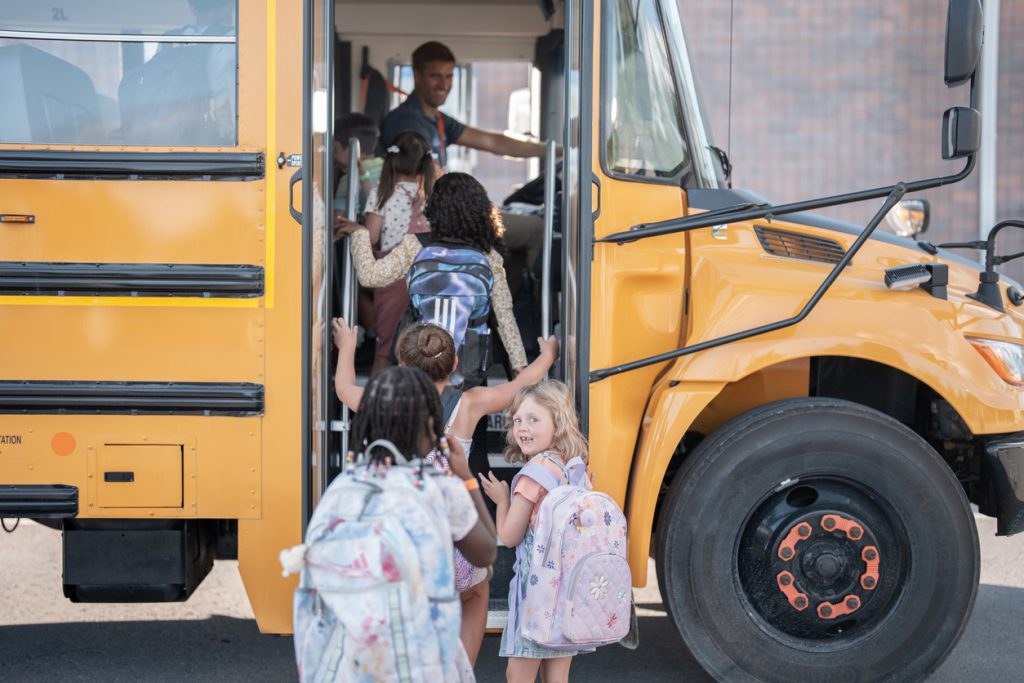
Parents/guardians are encouraged to monitor communications and updates distributed through the following channels:
- The CÉF emergency messaging system available through the CÉF mobile app.
- The CÉF’s social media channels, including its X (formerly Twitter) feed.
- The CÉF website: ecolefrancophone.com
- Their child’s school website.
- The communication system used by the transportation service provider.
- Radio-Canada platforms (e.g., radio broadcasts and website updates)
Code of Conduct
The rules of conduct are posted in all vehicles providing transportation services for the CÉF.
- Students must respect the driver and understand that they are under the driver’s authority and responsibility while being transported.
- The driver has the authority to assign student seating.
- The school’s code of conduct also applies while riding the bus.
- Each student is responsible for behaving appropriately to help ensure the safety of all students, the driver, and the public.
- Upon boarding, students must go directly to their assigned seat and remain seated at all times while the bus or vehicle is in motion.
- All personal belongings and body parts must remain inside the vehicle and must not obstruct the bus aisle.
- Students must allow the driver to focus on operating the vehicle safely.
- Students are not permitted to transport hazardous materials or consume alcohol, tobacco products, or any other controlled substances while using school transportation services.
- Students are expected to promptly report any bullying involving themselves or other students to a trusted adult, such as the bus driver, a teacher, a parent/guardian, or a school administrator.
Frequently Asked Questions
If a child enrolled in the four-year-old preschool program has a birthday in March, for example, does the sibling/friend accompaniment requirement still apply once the child turns five?
Yes, until the end of the school year.
Who determines who can serve as the accompanying friend, older brother, or older sister?
The parent(s)/guardian(s).
What is the minimum age requirement for the accompanying friend, older brother, or older sister?
The accompanying friend, older brother, or older sister must be at least six (6) years of age.
Can an accompanying friend, older brother, or older sister board the bus after the four-year-old child?
Yes, provided that a parent/guardian or their designated representative is present at the registered bus stop to accompany the four-year-old child until the accompanying friend, older brother, or older sister boards the bus.
Does the accompanying friend, older brother, or older sister have to sit in the same seat as the four-year-old child?
No. The accompanying friend, older brother, or older sister may sit in their regular assigned seat.
If the accompanying friend, older brother, or older sister is absent from the bus on a given day, can the four-year-old child still ride the bus that day?
Yes, provided that a parent/guardian or their designated representative is present at the registered bus stop to accompany the four-year-old
What is the role of the accompanying friend, older brother, or older sister?
The role of the accompanying friend, older brother, or older sister is to help ensure the safety of the preschool child by modelling appropriate behaviour on the school bus and, if the preschool-aged student has difficulty communicating with the driver, by acting as an intermediary.

CÉFRadio
Discover CÉFRadio, the radio station of the Conseil des écoles fransaskoises, featuring school and community news, along with radio and video productions created by Saskatchewan’s Francophone students.
Ajoutez votre texte de titrage ici
À Regina, une expérience pédagogique exceptionnelle pour les élèves de l’élémentaire
Ajoutez votre texte de titrage ici
Bilan très positif pour la Journée nationale de la vérité et de la réconciliation 2026 dans nos écoles
Ajoutez votre texte de titrage ici
Annonce d'un nouveau balado pour souligner la rentrée 2026 à l'école élémentaire Laval de Regina
Ajoutez votre texte de titrage ici
Levée de fonds record pour la Marche Terry Fox de Gravelbourg
Ajoutez votre texte de titrage ici
La passion du français et de l’espagnol au Festival Mosaic de Regina
Ajoutez votre texte de titrage ici