
Distance Learning in the 21st century
Committed to meeting the needs of 21st-century learners, the Conseil des écoles fransaskoises (CÉF) continues to innovate in the delivery of teaching and learning. Mobile laptop carts are available to students to support research and provide timely access to educational resources. In addition, distance education has become a key educational option for students in Grades 7 to 12, enabling them to:
- have equitable access to learning for everyone, anytime and anywhere;
- have access to specialized teachers in the subject being studied;
- access an innovative approach to learning while meeting curriculum expectations;
- develop essential 21st-century and career-ready skills, such as:
- time and priority management;
- digital literacy and technology use;
- information management;
- virtual communication and collaboration;
- critical thinking skills.


The CÉF is continually reviewing and improving its distance learning services. We encourage you to visit this page regularly for the latest information on our educational programs and service offerings.
To learn more about distuance education at the CÉF, call us toll-free at 1-877-273-6661 or write to educationdistance@cefsk.ca
Distance Learning Course Registration
Registration for distance learning courses takes place before the start of each semester. Below is the list of courses offered for the current school year, along with course descriptions by category:
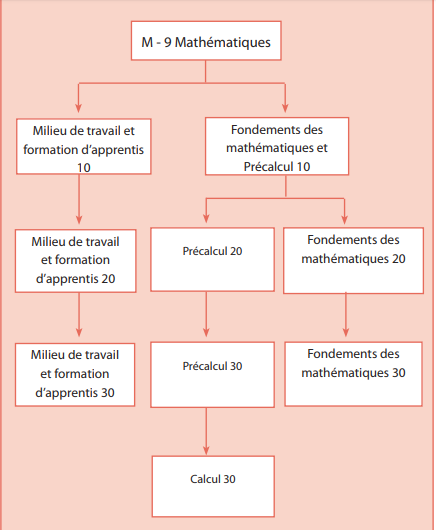
According to the mathematics requirements for a Saskatchewan high school diploma, students must complete one Grade 10 mathematics course and one Grade 11 (Level 20) mathematics course. All three pathways enable students to develop mathematical understanding and knowledge while strengthening their critical-thinking skills. When selecting a pathway, students should consider both their current and future interests. Students, parents, and teachers are encouraged to review admission prerequisites for post-secondary programs, as these requirements may vary from one institution to another and from year to year.
Foundations of Mathematics and Pre-Calculus 10 (FMP 10)
- Prerequisite course for the Pre-Calculus and Foundations of Mathematics pathways.
- This course is strongly recommended unless you are certain that you plan to follow only the Workplace and Apprenticeship Mathematics pathways.
Workplace and Apprenticeship Mathematics Pathway: WAM 10 – WAM 20 – WAM 30
- Courses in this pathway prepare students for career paths leading to skilled trades and employment in the workforce.
- This pathway is particularly well suited to students who enjoy hands-on learning and practical applications.
- Approximately 30% to 40% of students graduating from Grade 12 pursue careers for which the mathematics courses in this pathway are appropriate.
Pre-Calculus Pathway : PC 20 – PC 30 – Calculus 30
- The content in this pathway has been designed to meet the needs of students interested in careers in science-related fields.
- Approximately 10% to 20% of Grade 12 graduates pursue careers for which the mathematics courses in this pathway are appropriate.
- Calculus 30 is not shown on the course pathway diagram; however, it will continue to be offered.
It is taken after Pre-Calculus 30.
Foundations of Mathematics Pathway: FOM 20 – FOM 30
- The content in this pathway has been designed to meet the needs of students who plan to pursue careers that require a university degree but involve relatively little mathematics, such as the humanities, fine arts, social sciences, and nursing.
- Approximately 40% to 60% of Grade 12 graduates pursue fields of study and careers for which the mathematics courses in this pathway are appropriate.
In Grades 11 and 12, Saskatchewan’s science program is organized into a number of different pathways. The diagram below illustrates the various pathways and courses, as well as the connections between them.
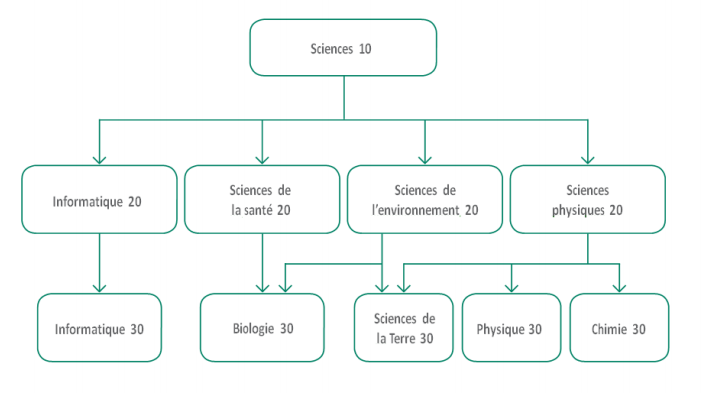
According to the science requirements for a Saskatchewan high school diploma, students must complete one Science 10 (or Science 11) course and one Science 20 (or Science 21) course.
The various science pathways support the development of scientific literacy for all students. Scientific literacy is an evolving combination of attitudes, skills, and scientific knowledge. It enables students to develop scientific inquiry skills, solve problems, make informed decisions, foster a lifelong love of learning, and maintain a sense of wonder about the world around them (translation of excerpt from CMEC, Cadre commun des résultats d’apprentissage en sciences de la Nature M à 12 : Protocole pancanadien pour la collaboration en matière de programmes scolaires, 1997, p.4.)
When selecting courses, students should consider both their current and future interests. Students, parents, and teachers are encouraged to review admission requirements for post-secondary programs, as these prerequisites may vary from one institution to another and from year to year.
All courses within the different science pathways are taught and mastered with the same level of rigor. No pathway or course is considered an “easy science” option. Rather, each pathway offers a different science focus designed to meet different educational and career goals.
For more information, please visit the following website:
Science 10
Science 10 introduces Grade 10 students to the provincial science curriculum and is based on the Pan-Canadian Protocol (Common Framework of Science Learning Outcomes).
Course Goals:
- Understand the nature of science and the relationships among Science, Technology, Society, and the Environment (STSE).
- Build scientific knowledge.
- Develop scientific and technological skills and competencies.
- Develop attitudes that support scientific habits of mind.
The course consists of three units representing the major areas of science:
- Biology: Climate and ecosystem dynamics
- Chemistry: Chemical reactions
- Physics: Forces and motion in our world
Science 10 is a prerequisite for all Grade 11 science courses.
Physical Science 20 (S)
This course integrates concepts from both chemistry and physics and takes a hands-on approach to exploring topics related to heating and cooling, the foundations of chemistry, including the mole concept and quantitative analysis of molecules and chemical reactions, as well as the characteristics and properties of electromagnetic waves.
Prerequisite: Science 10
One of the course’s central themes is the study of scientific activities in both the public and private sectors, particularly in agriculture, industry, and universities, to help students better understand career opportunities in the physical sciences. Through research and inquiry-based learning, students are encouraged to independently explore phenomena related to the physical sciences.
Environmental Science 20 (S)
This biology-based course focuses on the study of the environment.
Prerequisite: Science 10
The course includes:
- an introductory unit on the interdisciplinary nature of environmental science;
- a unit on the atmosphere and human health;
- a unit examining human populations and pollution;
- a unit on aquatic ecosystems; and
- a unit on terrestrial ecosystems.
If time permits, students will also complete an independent study project and explore career opportunities in environmental fields.
Biology 30 (S)
Prerequisite: Health Science 20 or Environmental Science 20
The main themes of this Biology 30 course include examining the significance of evolution as a unifying concept in biology and exploring what life is and how it changes over time. Students investigate the organization of life across all kingdoms through the study of biomolecules, cellular processes, and organism development.
In the areas of genetics and biotechnology, students explore heredity and the ways in which information is stored, transmitted, and expressed at both the chromosomal and molecular levels.
Through scientific inquiry, students conduct independent investigations and deepen their understanding of biological phenomena.
Chemistry 30 (S)
Prerequisite: Physical Science 20 (students should have a strong foundation in mathematics and have completed Pre-Calculus 20 or Foundations of Mathematics 20 before taking Chemistry 30).
This course focuses primarily on examining how chemical properties and bonding determine the suitability of materials for specific uses and applications. Students will investigate the nature of chemical equilibrium and the factors that influence chemical reactions.
In the study of electrochemistry, students explore oxidation-reduction (redox) reactions and their impact on society and the environment. Additional topics include organic compounds and acid-base chemistry.
Student inquiry plays an important role in the course, as students use their own questions to guide independent investigations of selected chemical phenomena.
Physics 30 (S)
Prerequisite: Physical Science 20, and it is strongly recommended that students have successfully completed Pre-Calculus 20 before taking this course.
This course gives students the opportunity to explore concepts related to modern physics, including quantum mechanics, relativity, and nuclear physics. Students use Newtonian mechanics to analyze various types of motion and the forces that cause them.
Using the laws of conservation of momentum and energy, students analyze and predict the outcomes of interactions between objects. They also investigate magnetic, electric, and gravitational fields and the interactions between them.
Student inquiry is an important component of the course, as students use their own questions to guide independent investigations of selected physical phenomena.
Psychology20 (A)
This course introduces students to social psychology and the related terminology.
Students will have the opportunity to develop a better understanding of themselves and their relationships with others. They will explore how human beings behave and interact within social environments. Students will examine and explain the influence that the real, imagined, or implied presence of others has on our thoughts, feelings, and behaviours.
Law 30 (A)
As part of the broader field of social sciences, Law 30 contributes to the development of informed and responsible individuals who understand their legal rights and responsibilities.
Students will gain an understanding of the law and the processes involved in the administration of justice. They will also explore how laws reflect the values and attitudes that shape human and social relationships.
Psychology 30 (A)
This course focuses on human growth and development and on the major theoretical perspectives used to interpret behaviour throughout an individual’s lifespan.
Students will examine the physical, cognitive, social, and emotional aspects of development. They will also explore how social context, community structures, education, and cultural, philosophical, and political values influence human development.
Spanish 10, 20, 30 (Academic and Modified)
The Spanish curriculum enables students to acquire the knowledge, skills, and attitudes needed to understand and communicate effectively in Spanish.
The program is based on the Communicative-Experiential Approach, which encourages students to use the language to complete everyday tasks, communicate ideas, obtain information, and accomplish meaningful objectives. This approach focuses on how language is used in real-life situations.
The curriculum is organized around four interconnected components:
Communication – using Spanish to communicate with others;
Information Gathering – obtaining information for a specific purpose;
Creative Expression Appreciation – developing an appreciation for creative and artistic works;
Culture and Society – exploring and appreciating another culture and its society.
Through these components, students develop their language proficiency while gaining a deeper understanding of the Spanish-speaking world.
In Visual Arts 10, 20, and 30, students:
- participate in artistic inquiry to explore their own ideas, the ideas of others, and diverse worldviews;
- experiment with a variety of artistic practices, techniques, and materials;
- develop their own artistic style and voice;
- collaborate with peers, teachers, and community mentors;
- learn about the historical and contemporary work of artists from Saskatchewan, Canada, and around the world.
Visual Arts 10, 20 and 30
Creative/Productive Goal: Students engage in inquiry-based processes to create, communicate, and express ideas through visual art.
Critical Response and Appreciation Goal: Students respond to diverse forms of artistic expression from Saskatchewan, Canada, and around the world through critical thinking, research, creativity, and collaborative inquiry.
Culture and History Goal: Students engage in inquiry to explore the content and aesthetics of the arts in a variety of cultural, historical, and contemporary contexts, while developing an understanding of the connections between the arts and the human experience.
Practical and Applied Arts Requirements for Graduation
Note: Within the 24 cumpulsory credits required for graduation, PAA courses may count toward one of the following requirements:
- 2 credits in PAA or Fine Arts (Grade 10, 20, or 30);
- 6 elective credits (2 at the Grade 10 level and 4 at the Grade 20 or 30 level).
Purpose of the PAA Program
Through its Practical and Applied Arts (PAA) program, middle years and secondary education in Saskatchewan addresses many of the challenges of modern society by helping students develop foundational knowledge and by preparing a skilled and adaptable workforce.
In our information-based Canadian society, characterized by rapid economic and social change, students need confidence in their ability to adapt to change and respond to the challenges they will encounter in their personal and professional lives. In particular, they must consider what they will do after completing high school. Many students will enter the workforce, while others will continue their education. Students must become independent and responsible in order to enter an already highly competitive labour market or pursue post-secondary studies.
Schools across the province also face challenges. They must continually provide high-quality programs in a cost-effective manner, while ensuring that parents and communities view those programs as relevant. The PAA program enables schools and students to meet these challenges. Schools can respond more effectively to the needs and learning outcomes of students within their communities by using the flexibility of PAA programming to develop courses and facilitate access to school and community resources, as well as distance learning opportunities.
Students develop the confidence they need to become adults and take greater responsibility for their studies, the development of their talents, their interests, and their personal skills. They also learn to set goals and make the efforts necessary to achieve them. As an important component of Saskatchewan’s core educational program, PAA supports student success by establishing clear learning outcomes and recognizing achievement. Ultimately, the PAA program develops students’ competencies, including their knowledge, skills, and attitudes, in other words, what they know and what they are able to do.
Design Studies 20 (7104)
Design is an integral part of our society. It permeates every aspect of civilization, sometimes in complex ways and often in very simple ones.
Design is an everyday activity. It gives order to our world. Young children at play design physical structures, visual images, and organizational systems. Professional designers do the same and much more. Signs, displays, packaging, transportation systems, computer games, furniture, automobiles, clothing, banquets, houses, and buildings are only a few examples of the work carried out by design professionals.
Not all students will pursue careers in design, but everyone uses design in one way or another. The Design Studies program helps students become aware of design in their environment, engages them in design activities, and teaches them how design methods are used in a variety of contexts. By becoming aware of and appreciating the importance of design, students learn to become effective members of society.
Design can be described as “an innovative method of problem solving that begins with the identification of a specific human need and ideally results in a product or situation that improves or enhances some aspect of our lives.”
The word design may describe a condition, as in the statement, “Your design demonstrates creativity.” The verb to design, however, refers to a process or activity aimed at solving a problem, as in, “I need to design a container to transport water.” Students in Design Studies work primarily within the context of the verb.
All students need to develop problem-solving skills throughout their schooling. The Design Studies program specifically addresses problem solving in a variety of contexts and is limited only by practicality and imagination.
Entrepreneurship and Innovation 20 (7107)
Entrepreneurial individuals are agents of change.
They put ideas into action. They recognize opportunities to improve products, services, and methods, and they mobilize resources to meet challenges and create innovations. They develop new ways of responding to the many changes and challenges encountered in an increasingly competitive and interdependent world.
Schools can play a vital role in helping students become more entrepreneurial and innovative. The Entrepreneurship and Innovation area of study is designed to challenge secondary students of all ability levels to expand their self-confidence, experience, and innovation and leadership skills. These skills encourage students to recognize how they can apply their abilities to succeed in a variety of careers, whether as volunteers, employers, or employees.
In the business world, entrepreneurship depends largely on the ability to be enterprising and innovative. Entrepreneurship involves recognizing opportunities, needs, wants, and problems, and using resources to implement innovative ideas in the creation of thoughtfully planned new ventures. Intrapreneurship, on the other hand, refers to entrepreneurial activity within an existing organization.
In Entrepreneurship and Innovation, entrepreneurial thinking is used consistently as a learning context, helping students develop expertise in a variety of areas.
The program helps students understand basic economic principles and management practices. It also provides them with an understanding and appreciation of the important role that small business, entrepreneurship, and self-employment play in our society.
Financial Literacy 20 (7111)
In our complex and ever-changing world, the ability to manage personal finances is becoming increasingly important.
Financial literacy, one of the most essential practical life skills, is now required in virtually every area of activity.
The Financial Literacy modules enable students to learn how to obtain and use financial information and understand its personal and professional applications, opening the door to a wide range of opportunities.
Through the Practical and Applied Arts program, students taking Financial Literacy may:
- develop an appreciation for ethical practices in personal and business financial management;
- become aware of the impact of economics on individuals, society, and the labour market;
- develop knowledge, skills, and attitudes that apply directly to financial management and more broadly to career opportunities in the workforce;
- develop skills such as decision making, problem solving, and communication that demonstrate initiative, creativity, and adaptability in a constantly changing financial environment.
Management and Marketing 20 (7112)
Prerequisite: Entrepreneurship and Innovation
In today’s highly competitive and rapidly changing society, management and marketing are essential skills.
Whatever students do, they manage themselves or the resources available to them. They also promote themselves, the services they provide, or the products they create.
The Management and Marketing program within Practical and Applied Arts (PAA) is designed to help students develop the skills needed for the effective and profitable application of management and marketing systems and strategies in personal, family, business, community, and global contexts.
Management focuses on identifying effective procedures for organizing resources and working with others. Marketing, on the other hand, deals with the promotion and distribution of ideas, goods, and services to satisfy consumer needs and wants.
Within this area of study, marketing is examined primarily from a retail perspective. The central theme of marketing systems and strategies is connecting students’ experiences as consumers with marketing in the retail sector. Drawing on their own experiences, students are encouraged to consider marketing from the perspective of retail employees, managers, and business owners. Students learn marketing strategies that help ensure the right products or services are available in the right place, at the right time, in the right quantity, at the right price, and for the right customers.
Management focuses on how to operate a business and manage information within a competitive environment in order to generate profit. Knowledge, skills, and attitudes are developed to help students identify and analyze strategies that contribute to success in constantly changing environments.
Students build competence and self-confidence through a variety of practical experiences that involve planning, organizing, directing, leading, teamwork, monitoring growth, and communicating effectively. Their goal is to provide professional-quality service.
This area of study gives students the opportunity to explore management and marketing systems and strategies that are complex and continually evolving. Its ultimate purpose is to help students acquire the essential knowledge and skills needed to contribute effectively and immediately in entry-level positions.
Journalism 20L (6038)
Students who take this course will:
- understand and respond critically to media;
- understand radio and television production;
demonstrate effective writing and production techniques; - use French to listen, view, read, write, discuss, and produce a variety of media;
- apply critical thinking and analyze various types of documents;
- understand technology as a means of communication;
- recognize the characteristics of quality journalism.
Module 1 – Introduction to Journalism
- Different reading strategies
- Characteristics of an effective summary
- Creating a blog
Module 2 – Research and Reporting
- The art of interviewing
- Media events
- Internet research
Module 3 – Writing Skills
- The inverted pyramid method
- Headline writing
- Feature articles
- Editorials and columns
- Ten tips for effective writing
Module 4 – Specialized Journalism
- Arts and entertainment reporting
- Sports reporting
- Music journalism
- Ethics and the law
Module 5 – Multimedia
- Photography
- The use of images
- Video Reporting
- Video planning
- Producing a video report
- Conducting a television interview
- Production techniques
- Editing and post-production
- Audio Reporting
- Radio journalism
- Audio equipment
- Audio editing software
- Producing a radio report
Agricultural Practices 20 (7102)
Agriculture is a diverse field that is important to both urban and rural communities. It affects the quality of life enjoyed by all Saskatchewan residents.
Agriculture includes not only primary production but also processing and service industries. It is Saskatchewan’s second-largest economic sector after the oil and natural gas resource industry.
Growth and development opportunities in agricultural products and technologies are promising. The continued prosperity of the agricultural industry in both local and international markets can be supported through value-added food production and by diversifying products and services to meet consumer needs.
Agriculture relies on some of our most fundamental resources: soil, water, plants, animals, and people. Environmental concerns continually drive the development of new technologies and methods to manage interactions among these resources. Industry practices must ensure the sustainable use of our natural resources.
Within Practical and Applied Arts, the Agricultural Practices course provides students with an overview of agriculture in Saskatchewan, including:
- crop and livestock production;
- indoor and outdoor landscaping;
- animal husbandry;
- the agri-food industry;
market research and development; - environmental management.
Consistent with the philosophy of Practical and Applied Arts, students who take Agricultural Practices will develop the knowledge, skills, attitudes, motivation, and commitment necessary to work both independently and collaboratively as citizens and members of the workforce, while conserving and using land, water, air, forests, wildlife, and other natural resources responsibly.
Students will:
- develop a greater awareness of the economic, environmental, and social importance of agriculture in society and the global marketplace, as well as the factors that influence decision-making in the agricultural sector;
- describe the characteristics of Saskatchewan agriculture and horticultural industries and identify the products and services they provide;
- describe technologies and research initiatives designed to support product and service development while promoting the sustainable and responsible use of natural resources;
- translate development and conservation goals into viable plans for the development and marketing of agricultural and horticultural products and services.
Communications Technology 20 (7118)
In our technology-based society, characterized by rapid social, economic, and technological change, students must be prepared to use information and technology effectively and efficiently.
Communications Technology introduces students to presentation and communication techniques, photography, printing, and audio/video production.
The knowledge and skills acquired through Communications Technology can be applied across all core and elective subject areas. They help students present their ideas and viewpoints more effectively, understand the perspectives of others, and successfully complete school projects.
For example, students are no longer limited to writing essays or preparing written reports. They can apply a wide range of skills learned in Communications Technology to complete school assignments. These skills are also useful in everyday life.
As the communications industry becomes increasingly complex and continues to evolve, it is essential for students to develop a strong understanding of media and technology. Students need exposure to emerging digital technologies and their applications in printing, photography, animation, and audio/video production.
These skills may be used professionally or for personal purposes. The ability to communicate effectively is essential for success in virtually any career. Students who can communicate effectively through a variety of media will have a significant advantage as they enter the workforce in the information age of the twenty-first century.
Tourism 20 (7120)
Tourism is a network of human interactions. It is sometimes described as a system, sometimes as an activity, and often as an industry.
This global phenomenon, which plays an important economic role, results from people’s decision to travel. Travel may involve visiting family or friends, attending business meetings, or simply taking vacations. Participation in tourism activities helps people gain a deeper understanding of the world and its inhabitants.
Travel brings cultures closer together and fosters an appreciation for cultural diversity. Tourism has often been described as the “industry of peace” because it promotes understanding, acceptance, and appreciation of others.
In recent years, tourism in Saskatchewan has experienced significant growth. It is one of the province’s largest industries, employing thousands of people and generating substantial revenue.
Travel by Saskatchewan residents within the province accounts for a large portion of the tourism industry. Tourism is a sustainable industry that includes businesses, organizations, associations, and government agencies that provide transportation, products, services, accommodations, facilities, programs, and resources.
The quality of service and hospitality often determines the success or failure of tourism operations. Whatever career students choose, they will need fundamental skills such as:
- communicating effectively;
- anticipating and responding to customer needs;
- maintaining a professional appearance and conduct.
The Tourism program provides practical situations in which students can develop and demonstrate these important skills.
The program gives students an overview of the economic, social, and environmental influence of tourism in Saskatchewan. Students gain an understanding of tourism’s current and potential contribution to their community, Saskatchewan, Canada, and the world.
At the same time, students learn that tourism can negatively affect the cultural and physical resources upon which the industry depends. Local tourism planning and development require cooperation among the private sector, the public sector, individuals, and organizations. Well-considered and innovative local decisions can produce cultural and economic benefits for an entire community.
As future employees, business owners, and citizens, students will develop a deeper understanding of the importance and consequences of tourism development and tourism-related activities.
The Tourism curriculum enables students to connect practical, hands-on learning with more abstract and theoretical learning. By developing foundational and career-related knowledge, skills, and attitudes, students gain the flexibility needed to adapt to a variety of situations and to meet the challenges of their personal lives, careers, and future studies with greater competence and confidence.
Ethics and Citizenship 10 (A)
This course enables students to express their ideas about their worldview and their behaviour in relation to values and the social order within society.
Students will have the opportunity to explore a variety of themes, including values and norms, cultures and societies, religious heritage, symbols and representations, the influence of religious traditions on society, literature and the media, the influence of family, society, and the media, as well as stories, rituals, and rules. Students will also reflect on questions related to their own identity.
Ethics and Citizenship 20 (A)
This course enables students to examine the principles that underlie justice and to develop a deeper understanding of the world’s major religious traditions and cultures, including Judaism, Christianity, Islam, Catholicism, and First Nations and Métis spirituality.
Students will also explore the complexity of human nature, discuss what is commonly referred to as religious experience, and reflect on questions concerning the future of humanity.
Ethics and Citizenship 30 (A)
This course is designed to help Fransaskois students acquire the knowledge and skills they need to become responsible, informed, engaged citizens who recognize their ability to contribute to positive change within their community, society, and the world.
The curriculum also encourages students to explore life choices, behaviours, and attitudes in relation to the diverse religions and belief systems found throughout the world.
Éducation chrétienne 10 (A)
This course focuses on students’ ability to question and reflect on important existential issues commonly experienced during adolescence, including the search for identity, the quest for meaning, the reality of God, the desire for freedom and truth, and relationships with others.
The course encourages students to reflect upon and articulate a vision of God, the human person, and the world through the lens of the Catholic tradition, with the goal of helping them grow personally and recognize their contribution to the development of society.
Éducation chrétienne 20 (A)
This course continues to develop students’ ability to question and reflect on important existential issues common to this stage of life, including the search for identity, the quest for meaning, the reality of God, the desire for freedom and truth, and relationships with others.
Students are encouraged to reflect upon and articulate a vision of God, the human person, and the world through the perspective of the Catholic tradition, with the aim of supporting their personal growth and their contribution to the development of identity.
This course is a continuation of Units 1 to 3 of Christian Education 10.
Éducation chrétienne 30 (A)
This course enables students to explore the Catholic faith in dialogue with Judaism, Islam, and the major religions of Asia.
Students discover a variety of beliefs and traditions and develop research and analytical skills that help them better understand the Catholic faith within a pluralistic world. Students examine the major dimensions of religious experience and explore the influence of religion on our way of life and on the ways we interact with others.
Responsibilities of the Distance Education Coordinator
- Register students with the Ministry of Education.
- In collaboration with school principals, establish distance learning course schedules.
- Follow up with school principals regarding student registration.
- Manage the distance education budget.
- Coordinate with the technology team and the CÉF regarding equipment purchases.
- Oversee the purchase of software required for the effective delivery of distance learning courses, including the acquisition and verification of licences.
- Stay informed about best practices and emerging technologies in distance education.
- Supervise distance education teachers.
- Promote distance learning courses.
Roles and Responsibilities of Students Enrolled in a Distance Learning Course
- Meet the requirements outlined in the course syllabus to successfully complete the course.
- Ensure that all course materials have been received.
- Follow the course schedule and meet deadlines for assignments and assessments.
- Communicate regularly with the teacher and, where applicable, the Inclusive Education Assistant.
- Follow the appropriate procedures when technical or instructional challenges arise.
- Submit assignments by email or fax as soon as they are completed.
- Review and apply the teacher’s comments and suggestions on marked work in order to improve future assignments.
- Consult the distance learning calendar at the beginning of each course for course instructions and expectations.
- Make arrangements to catch up on missed coursework following an absence (for example, through recorded lessons or materials emailed by the teacher).
- Notify the teacher in advance of any planned absence.
- Contact the teacher and/or Inclusive Education Assistant as soon as any issues arise regarding online connectivity, instructions, course content, or other concerns.
- Consult and follow the calendar of distance learning courses.
Roles and Responsibilities of Teachers Delivering Distance Education
- Establish classroom rules and expectations in collaboration with students.
- Build a relationship with each student, get to know them, and understand their learner profile.
- Communicate course start and end dates.
- Develop and present the course syllabus.
- Encourage students to seek assistance before technical or academic challenges become overwhelming.
- Remind students to refer to the shared distance learning calendar.
- Respond to emails within 24 hours whenever possible, excluding weekends.
- Communicate with parents at the beginning of each semester and whenever a student falls behind in a course.
- Provide parents with regular updates on student achievement and progress.
- Stay informed about best practices and emerging technologies in distance education.
- Maintain a contingency plan for unforeseen circumstances.
- Meet with students at least once during every five-day cycle (for asynchronous courses).
- Provide feedback on assignments and examinations within three business days of receipt.
- Inform students at least 48 hours in advance of a classroom visit.
- Explain and manage the technological tools used for course delivery.
- Keep the distance learning course calendar up to date.
- Document interventions and communications with students using the CRMS software.
- Plan and share a schedule of meetings with students.
Roles and Responsibilities School Administration
- Register students on the distance education platform.
- When more than one student is enrolled in a distance learning course, assign an Inclusive Education Assistant to supervise participating students.
- Provide students with an appropriate learning environment.
- Establish a schedule for the Inclusive Education Assistant that includes student names, courses, and class times.
- Provide profiles of students with exceptional learning needs who are enrolled in distance learning courses.
- Inform the teacher, Inclusive Education Assistant, and/or information technology technician of any technological challenges.
- Inform students about the distance education options available to them.
- Provide the names of Inclusive Education Assistants involved in distance education and review their roles and responsibilities with them.
- Coordinate communication between families and the school for students enrolled in distance learning courses.
- Notify distance education teachers of schedule changes (activities, field trips, etc.) or student absences.
Responsibilities of the Inclusive Education Assistant
1. Supporting Student Learning
Under the supervision of the school principal and the distance education teacher, the Inclusive Education Assistant ensures that students have access to an individualized and appropriate learning environment by:
- Establishing an effective working relationship with students.
- Recording relevant information after each class in a logbook, including attendance, assignment deadlines, and other important details.
- Communicating student needs and challenges to distance education teachers.
- Encouraging and reminding students of the daily tasks required for academic success.
- Sharing students’ completed work with the distance education teacher.
- Listening attentively during videoconferences in order to provide support and troubleshooting assistance, individually or in groups when possible.
- Ensuring readiness before each class and confirming that videoconferencing technology is functioning properly when necessary.
- Preparing all materials required for distance learning classes.
- Fully supporting and promoting the philosophy and mandate of distance education.
2. Supporting School and Classroom Routines
The Inclusive Education Assistant supports school routines to encourage the participation of all students by:
- Modelling and reinforcing school and classroom routines during distance learning courses.
- Helping students recognize and understand established routines.
- Clarifying school and classroom discipline procedures for distance learning classes.
- Assisting distance education teachers and school administrators in identifying and understanding student needs.
3. Supporting Social Participation
The Inclusive Education Assistant helps students participate in all aspects of school life related to social engagement by:
- Modelling and reinforcing appropriate behaviour during distance learning courses.
Helping students understand and appreciate school guidelines and expectations. - Modelling and encouraging the use of French in interactions with peers, staff, and administrators.
- Supporting and encouraging students to develop independence and personal responsibility throughout their distance learning experience.
Francophone Home-Based Education
in Saskatchewan
The CÉF offers a Francophone home-based education program for eligible families in Saskatchewan. The following documents* provide detailed information about the program and include the forms required for registration:
*Please note that these documents are currently available in French only.
- Programme de scolarisation à domicile (Home-Based Education Program Guide)
- Points saillants des modifications apportées au programme de scolarisation à domicile (Highlights of Changes to the Home-Based Education Program)
- Scolarisation à domicile : comment obtenir des crédit du secondaire? (Home-Based Education: How can Secondary School Credits be Earned?)
- Formulaire d’inscription à l’éducation à domicile (Home-Based Education: Registration Form)
- Annexe B – Avis d’intention d’inscription (Appendix B – Notice of Intent to register)
- Annexe C – Plan éducatif écrit (Appendix C – Written Education Plan)
- Politique du CSF (CÉF Policy on Home-Based Education)